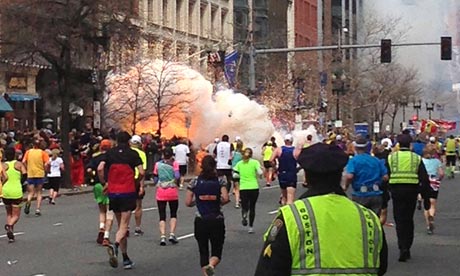
As the 2013 Boston Marathon bombing suspect Dzhokhar Tsarnaev's trial is coming nearer each day, complications have not been slight. One of the greatest obstacles heading into the trial is picking a jury that will be unbiased and balanced in its feelings. This trial is extremely controversial not only because Tsarnaev's supposed actions were within the vein of terrorism, but also because he murdered 3 people (including an 8-year-old boy) in a state that does not have capital punishment. However, because of Massachusetts' past, many are starting to believe that exceptions will be made.
Massachusetts abolished the death penalty more than 30 years ago and last carried out a death sentence in 1947. But a dark cloud hangs over the state's history and is very prevalent in the minds of any citizen that may become a juror in the trial. Massachusetts was the first colony to carry out capital punishment in 1630, hanging murderer John Billington in Plymouth. Mary Dyer and the three other "Boston Martyrs" was executed in 1660 under a law that banned Quakers from the Massachusetts Bay Colony. The Salem Witch Trials of the late 1690s killed a total of 19 women accused of practicing witchcraft. Massachusetts was also the state to execute the Italian anarchists Nicola Sacco and Bartolomeo Vanzetti, a killing that is still believed unjust to this day. In all, Massachusetts has executed 345 people. Many state residents believe that first-degree murder always results in a death sentence, even though this rule was only in effect until 1951.
Besides this, there is still ambivalence about capital punishment in Boston, and this makes picking a jury for the Tsarnaev trial extremely difficult. Though Massachusetts law does not allow the death penalty, the federal government does. It is clear that the federal government thinks Tsarnaev is a "poster boy" for capital punishment, because his crimes were so heinous and cruel.
At the moment, potential jurors for the trial are being "quizzed" and widdled down a group that will reach a fair and unbiased verdict. When asked whether they'd be able to sentence Tsarnaev to die by lethal injection, the answers from potential jurors range from "absolutely" to "no way" to somewhere in the middle. One juror responded, "I'm not wicked opposed to the death penalty." The people with the strongest opinions (those on the extreme ends of the juror questionnaire rating scale) are the least likely to make the jury. The city as a whole is also divided. A 2013 poll conducted by the Boston Globe showed that just a third of Boston's residents favor the death penalty for Tsarnaev, while the other two-thirds would choose life in prison as his sentence.
Despite this, there is a strong and emotional rally against Tsarnaev that spans most of America (for good reason). His defense lawyer has told the press many times that he is concerned that the "Boston Strong" sentiment will make finding an unbiased jury impossible, and also complicate reaching a truthfully fair punishment for Tsarnaev.
The main issues here are that the public's response to Tsarnaev's crimes and Massachusetts' history seem to be calling for an exception to the state law abolishing capital punishment. Also, there is talk about the federal government simply taking over the trial so that the death penalty can be incurred, as this is still legal in federal court. I am personally for the death penalty, but understand how it is believed that Tsarnaev will not receive a fair trial because of all the bias. Though the bias is definitely warranted, the rallying "Boston Strong" slogan is, in a way, obstructing justice to some degree. I also think that Massachusetts' history of "eye-for-an-eye" killings will also be a factor in the decision of this case.
Does Tsarnaev deserve to die? Can a fair jury ever be selected in a situation like this? Should the feds take over this case and allow for capital punishment? Is "Boston Strong" obstructing justice?
SOURCES
http://www.cnn.com/2015/02/19/us/tsarnaev-venue-hearing/index.html
http://www.cnn.com/2015/02/20/us/tsarnaev-13th-juror-selection-history/index.html