Wednesday, March 18, 2015

Republican Budget Plan to Cut Obamacare


The ten year blueprint for taxes and spending the House Republicans have proposed could balance the federal budget, even promising a surplus by 2024. Without relying on tax increases, the budget writers were forced to balance the budget while increasing military spending. Nearly $40 billion in “emergency” war funding was added to the defense budget for next year, raising military spending without breaking caps set by the 2011 Budget Control Act. The budget will also make “the Pell Grant program permanently sustainable.” 

But it comes at a price: the budget demands the full repeal of the Affordable Care Act, including the tax increases to finance it. Spending on Medicaid may fall $913 billion over ten years once the health program is turned to block grants to the states, but as House Republicans put it, “Our budget realigns the relationship the federal government has with states and local communities by respecting and restoring the principle of federalism.” Billions would also be cut from the Supplemental Nutrition Assistance Program, better known as food stamps. Domestic programs would be cut $519 billion below the already restrictive caps set in 2011. White House officials estimated that 37 million people would lose health insurance between the Affordable Care Act repeal and Medicaid cuts; this more than doubles the ranks of the uninsured.

“What we’re seeing right now is a failure to invest in education, infrastructure, research and national defense. All the things that we need to grow, need to create jobs, to stay at the forefront of innovation and to keep our country safe,” President Obama commented.

I believe that a full repeal of the Affordable Care Act would benefit the Americans more than a raise in military spending. In addition, I am uncertain that the budget will be balanced in such a short amount of time, and that it would require more than ten years to do so. What do you think? How do you feel about the changes in the budget? How will the American citizens be affected by these changes?

Link:
http://www.nytimes.com/2015/03/18/us/politics/house-republican-budget-overhauls-medicare-and-repeals-the-health-law.html

Sunday, March 15, 2015

The CIA Accidentally Funded Al Qaeda


A number of letters between Osama Bin Laden and other Al Qaeda officials were unearthed in the recent Brooklyn trial of Abid Naseer, a man convicted of plotting to bomb a British shopping mall. Not surprisingly many of these documents discussed the United States. What was shocking, however, was what one correspondence between Bin Laden and a top Al Qaeda commander, Atiyah Abd al-Rahman, revealed to be US contributions to Al Qaeda. 
In 2010, Afghan officials negotiated a $5 million dollar release of an Afghan diplomat held hostage by the terrorist organization Al Qaeda. Afghan security officials struggled to pay the steep price on their own, so they drew from money that they had saved from a secret fund. This treasury was, according to Afghan officials, financed by monthly cash payments from the CIA to Kabul’s presidential palace. Over the course of several years, Afghan officials had “squirreled away” nearly $1 million from the fund, and in 2010 handed that money to Al Qaeda in exchange for their diplomat.
            Al Qaeda has since used this $1 million in CIA money, as well as the $4 million drawn from other countries, to replenish its resources. Unfortunately, this money undermined the CIA’s efforts to deplete the organization’s treasury, namely their relentless campaign of drone strikes in Pakistan. In fact, had Al Qaeda not received such funding, they would have suffered immensely from the decimation of the upper military ranks. However, since “God blessed [them] with a good amount of money,” according to al-Rahman, they were able to stockpile weapons and fund other operational needs.
            Now what is possibly most disturbing about this whole situation is that the CIA didn’t know it was happening. Although Osama Bin Laden, who was alive at the time, feared that “there [was] a possibility…that the Americans [were] aware of the money delivery…and that they accepted the arrangement of the payment on the basis that the money [would] be moving under air surveillance,” the United States was relatively ignorant. In fact, the CIA continued dropping off cash amounts, which ranged from a few hundred thousand dollars to more than $1 million, at the presidential palace in Kabul until last year. They stopped when President Hamid Karzai stepped down.
            Since news of the event has broken, the CIA has declined to comment.
            Now, this story raises quite a few questions, the most obvious being how could the CIA have been unaware that American dollars were being used to fund terrorist organizations? Perhaps it is more important, however, to ask why the CIA was even delivering these secret funds to Afghanistan in the first place. According to the NYT, the money was used to buy the loyalty of warlords, legislators, and other Afghans and to create a patronage network that secured President Karzai’s power base. One Afghan official commented that there are little to no American constraints on such contributions and “once [the cash is] at the palace, [the CIA] can’t do a thing about how it gets spent.”
            Personally, I’m furious to learn that not only has the CIA inadvertently been funding Al Qaeda but also that they are so willingly to give money that they do not even enforce guidelines on how it must be spent. They are so concerned with buying loyalty that they fail to read the fine print of their arrangements. But, what do you think about this situation; what does the CIA’s accidental contributions to Al Qaeda say about the American government? Should the CIA be held accountable for their actions? Moreover, should we reassess how we attempt to influence Middle Eastern policies because, at least based on the evidence of the past few years, our efforts seem to be doing more harm than good?

Sources:


Thursday, March 12, 2015

Clinton's Emails Could Be Recovered


Over the past week, the latest controversy has been revolving around Hillary Clinton and emails which were sent from her personal account. She has not disclosed these emails to Congress which has caused many issues, and lead to a few people attempting to make progress in recovering some of these documents. House Oversight Committee Chairman Jason Chaffetz is planning on sending the State Department a letter requesting these emails, and could subpoena them if necessary. Even though Clinton has come forth stating that these emails are personal, the committee retains the authority to do so if necessary. 

Chaffetz is not the only one trying to have these emails disclosed. Marcus Rogers, of Purdue University's Cyber Forensics and Security Program, commented on the issue, stating that emails are incredibly difficult to erase completely. Trey Gowdy, chairman of the House committee investigating the attack on the U.S. consulate in Benghazi, said Wednesday that he wanted an independent review of the server. If the server, which these emails were sent from, was obtained, then the process of getting these files would be much more convenient. But, Clinton argued that she will not turn over the server that housed her personal email under any circumstances. 

What makes this controversy even more suspicious than refusing to give out these emails, is that she deleted about half the 60,000 emails sent through her personal account and the rest, deemed to be official, were sent to the State Department. She also has begun to contradict herself by saying that she chose not to keep her personal emails, but in Silicon Valley about two weeks ago, she said, "I don't throw anything away, I'm like two steps short of a hoarder." 

In my opinion, I believe that there are emails that she sent regarding the Benghazi scandal, or other governmental work, which is obviously not allowed. If she honestly did not have any emails that regarded any governmental work on her personal account, I don't understand why she just will not hand over the server to keep the good graces with the government. An issue like this hurts her chances for potentially running in 2016, and she should do whatever she needs to to keep her reputation clean. What do you think? Does Hillary have the right to keep these emails to herself? What move would be best for her public image? 

http://www.cnn.com/2015/03/11/politics/hillary-clinton-emails-jason-chaffetz-subpoena/index.html
http://www.marketwatch.com/story/hillary-clintons-emails-could-be-recovered-experts-believe-2015-03-12
http://www.msnbc.com/msnbc/unanswered-questioned-hillary-clinton-emails

Thursday, March 5, 2015

Mitch McConnell Tells States to Ignore the EPA

Senate Majority Leader Mitch McConnell (R-KY) meets with reporters on Capitol Hill in Washington on Feb. 24, 2015.

Yesterday, Senator Mitch McConnell, Republican of Kentucky and majority leader, is urging governors to defy President Obama by refusing to implement the administration’s global warming regulations.
The Obama administration is working on an aggressive climate change agenda to reduce the number of green house gas emissions that are coming out of our nation. He is working towards making the country a greener place, even if it means cutting some of the energy sources in our nation. The Keystone XL Pipeline is one piece of legislation in the news today that is working against Obama’s climate change agenda. Obama is working with the EPA and creating rules, which should be finalized in the summer, requiring each state to submit a plan detailing how it would cut coal-fired power plant pollution. Once implemented, the plans could lead to the closing of hundreds of coal plants. This would then lead to what the administration says, “a transformation of the nation’s energy economy away from fossil fuels and toward sources like wind and solar.” This sounds like a great idea for many environmentalists because it would decrease the nation’s largest source of planet-warming pollution, but many states and production plants are wary of this plan.
States like Kentucky, the state McConnell represents, that rely heavily on coal production or coal-fired electricity are worried that this legislation could ultimately freeze demand for coal. Republicans are also saying that Mr. Obama’s climate change policies are  an example of government overreach that could threaten jobs in the coal industry and many more. Already, 12 states, including McConnell’s home state Kentucky, have filed lawsuits opposing the plan and at least a dozen more are expected to file similar suits.
          Mr. McConnell told the press that he wants the states to not listen to ignore the EPA. He is out right telling states to violate what could be federal law if they listen to him. Mr. McConnell urged governors to fight the regulations by simply refusing to submit their state plans to the federal government. McConnell has made clear that he intends to use all legal, legislative and political means available to fight Mr. Obama’s climate agenda. This will be easier for him now that Republicans have majority power in Congress.
 
          What do you guys think about this climate agenda war that has been going on between the Republicans and Obama administration? Do you think the states should accept or reject this new EPA legislation? Is Obama doing the right think while pushing for a greener state with all of these hurdles and energy plans? In my opinion, I support the Obama administration and their endeavors. We only have one nation I think we should keep it clean and safe. I understand now there are some pretty serious decisions to be made, but looking back I think we will be glad to know we decreased our pollution and sought out more sustainable forms of energy.
http://www.nytimes.com/2015/03/05/us/politics/mcconnell-urges-states-to-defy-us-plan-to-cut-greenhouse-gas.html?ref=politics&_r=0
http://www.msnbc.com/rachel-maddow-show/mitch-mcconnells-message-states-ignore-the-epa
http://www.bna.com/mcconnell-pushes-say-n17179923648/

Controversy over Obamacare in the Supreme Court Again


This past Wednesday the Supreme Court argued for over an hour over the meaning of a specific four word clause in the Affordable Care Act. The contention was over the meaning of the phrase "established by the states" and whether or not only individuals living in the 16 states that had already set up state funded exchanges, as opposed to the other 34 states that have federally facilitated exchanges. If the Court rules against the Obama administration in this particular argument, it could mean that 5 million individuals will no longer qualify for the subsidies.

Liberal justices claim that the text should considered in its full form, and not scrutinized for four words taken out of context. Justice Sonia Sotomayor questions why the four words were seemingly hidden in the body of the text and not more prominently featured. She says it was like hiding a "huge in thing in a mouse trap." Solicitor General Donald B. Verrilli Jr., supports the IRS in saying that the challengers argument "revokes the promise of affordable care for millions of Americans -- that cannot be the statute that Congress intended." 

On the other side, the argument was challenged by Antonin Scalia, saying that while it might not be what congress intended, it was what was written and therefore how it should be interpreted. The main concern of the Republican party seems to be if that Court ruled in favor of the Obama administration, it could open the door to abundant additional government spending. The final decision will most likely be announced by May or June of this year. 


In my opinion it is quite clear that the law was set up to include as many people as possible to receive the benefits that the act provides. I feel as though the four word clause that is causing so much controversy was written to include both state and federally facilitated exchanges, as Verrilli noted in court. What do you think? What was Congress's intention when writing this particular part of the act, and regardless of the intent, how do you think it should be interpreted? 

http://www.cnn.com/2015/03/04/politics/obamacare-supreme-court-oral-arguments/index.html

Thursday, February 26, 2015

Iran Hangs Obama and Attacks a US Carrier


             You don’t have to be an expert in world affairs to know that Iran and the US aren’t exactly friends. Since the Iran-Iraq War of the Reagan administration, the Western superpower and Middle Eastern nation have been in constant disagreement and have often engaged in outright hostility. Relations have soured even more since September 11th, after which President Bush dubbed Iran the “Axis of Evil.” In fact, relations have become so poor between the two nations that there are no formal diplomatic relations between the Republic of Iran and the United States.
            Despite their history of disagreement and tension, the two nations have started to cooperate, albeit uneasily. In 2014, they allied with one another against ISIL, and recently they have been engaging in nuclear talks in Geneva. Although the Iran-US relationship is by no means fixed and although their recent interactions have been marred by continued hostilities, many people have started to believe that the two nations are on their way to establishing peaceful and respectful diplomatic relations. That is, until Iranians hung President Obama and blew up a mock US aircraft carrier during naval drills.
On February 11, during Iran’s 36th anniversary celebration of the Islamic Revolution, Iranians burned an effigy of President Obama. Many citizens also carried signs depicting Secretary of State John Kerry as a devious fox while chanting “Death to America” and “Death to Israel.” The display was broadcast throughout the Middle Eastern nation and met with approval by key figures in the Iranian government, such as Defense Minister Hossein Deghan.
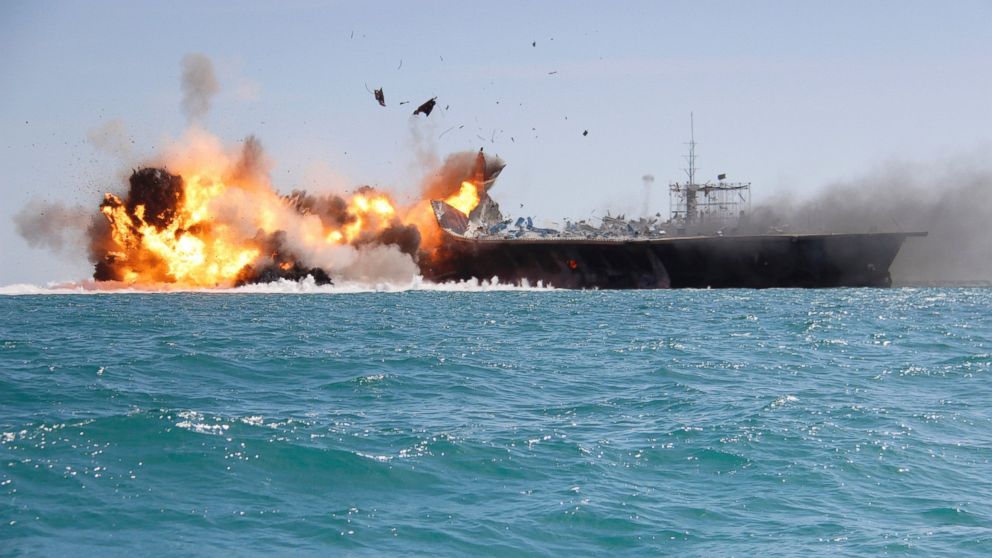
As if hanging the President did not send a strong enough message, on Wednesday, speedboats swarmed a life-size replica of the USS Nimitz, striking the vessel with missiles, rockets, and mortars. The simulation was called Great Prophet 9, and it was the centerpiece of training exercises of the Iranian Navy’s Revolutionary Guards. According to one video caption on a Fars report, “Iranian naval forces displayed their skills in targeting enemy vessels.”
Now, Nimitz-class carriers permanently patrol the water of the Persian gulf, something which Iran has always resented. By blowing up a ship designed in the image of these carriers, Iran is making its position clear; it may be cooperating with the United States on a few fronts at the moment, but the Western nation remains its archenemy. Not only that, but Iran may be attempting to show the United States that, if the worst occurs, the nation is not afraid to go to war against the American superpower. Iran can and will sink a US warship if conflict were to break out.
The navy’s Revolution Guards Corps also conducted mine-laying exercises. Ali Fadavi, commander of the Iranian naval force, stated that this portion of their war-games was “the most important concern of the Americans,” for Iran has “the most advanced sea mines which [the US] cannot…[imagine].” Another commander stated that the navy wasn’t trying to show off all its strength with these drills, but rather carry out simple practice exercises. Apparently, Iran still has many “capabilities which will remain covert and hidden before being used in action.”
Well, so much for improved relations. On a governmental and social level, Iran’s hatred of America just seems to grow. If there was any lingering doubt whether Iran still viewed the US as Public Enemy Number 1, there really cannot be now. We are Iran’s archenemy, and Iran is making sure that we are very much aware of this fact.
The US, however, doesn’t seem to be alarmed. The White House did not issue a formal response to the burning of President Obama’s effigy and, in regards to the naval attack, US Commander Kevin Stephens simply said, “We're quite confident of our naval forces' ability to defend themselves.”
            Now, I’m not one to support feeding international conflict, but I can’t help think that it seems a little arrogant, even dangerous, that the United States has completely discounted Iran’s recent moves. We have a problem with the Iranian government; they hate us and see us as hypocritical, selfish monsters. I think it’s our duty, as self-proclaimed “international peacekeeper” to address these attacks. If we ignore them, if we continue to belittle and discount Iran, aren’t we just setting ourselves up for future conflict with Iran and other Middle Eastern nations?
What do you think about these attacks? How will they affect the American-Iranian relationships? Do you support the United States’ dismissive response or do you think we should act differently in the face of such attacks? Most of all, do you think there is any hope for US-Iran relations in the near future?

Sources:


Republicans Threaten DHS Funding


In a showdown reminiscent of the fiscal cliff, debt ceiling, government shutdown, etc. of the past few years, the clock is rapidly ticking on funding for the Department of Homeland Security. However, with the Republicans in control of both chambers of Congress, the conflict has shifted to one between the two parties to a split within the GOP itself.

The DHS is set to run out of funding this Friday, something which shouldn't surprise anyone, least of all the Republicans. Upon gaining control of Congress, the party deliberately chose not to extend funding for the Department, which is responsible for executing President Obama's controversial executive action shielding millions of undocumented immigrants from being deported. Thus, the current stand-off was planned and engineered months in advance as a tool for blocking the president's program.

As things stand, there is a divide between House and Senate Republicans over how to handle the funding deadline. Senate Majority Leader Mitch McConnell surprised and angered many in his party by expressing his willingness to consider a clean resolution providing funding without touching immigration, a bill Senate Democrats have voiced support for. The proposed legislation passed a procedural vote 98 to 2 on Wednesday, and could go up for a vote as early as Thursday.

This legislative struggle is important on many fronts for the Republican Party. On the most basic level, DHS funding can be an effective proxy for defeating Obama's immigration plan. Additionally, the effort will demonstrate the organization and coordination of the party.

So far, however, it has proved the opposite. The Republican push has been uncoordinated and chaotic. On Wednesday, House Speaker John Boehner admitted to not having spoken to McConnell for two week, a baffling communication gap considering the importance of the upcoming bill. Furthermore, Boehner has yet to take a public position on the Senate's proposal, and has chosen a “wait and see” approach regarding a funding bill.

The Republicans are clearly divided over the best course to take. McConnell, who promised no new shutdowns in October 2013 [1], seems interested in securing DHS funding at nearly any cost. He has even offered two votes: one on a clean bill, and a second on a bill halting Obama's executive action. House Republicans, however, appear characteristically unwilling to compromise, and were upset by McConnell's cooperation with Democratic lawmakers. Iowa Representative Steve Kind criticized McConnell for having “tipped over his king,” or surrendered.

Alternative solutions have included a short-term funding measure, a joint committee between the two houses, and a bill rolling back certain portions of Obama's immigration policy. One interesting proposal has been funding the DHS, but on the condition that all funding will be pulled if Texas federal judge Andrew Hanen's recent injunction on Obama's executive action is overturned. It is unclear whether such an ultimatum would be enforceable or threaten the independent judiciary.

Thus, the Republicans appear to be at a stalemate. The party is split between moderates who want the DHS funded at all costs, and conservatives who want to see Obama's action on immigration blocked, and are willing to withhold the department's funding to do so. Now that they hold the Senate, the GOP establishment fears being blamed by the American people if a shutdown of the agency were to occur; on the other hand, compromise may elicit a backlash from House Republicans, many of whom have defied Boehner and the party mainstream. The Democrats, although a minority in both houses, are another wrench in the proceedings. Their support remains important in the Senate, where they have already filibustered opening debate on a funding bill four times.

Personally, I think that the Republicans are playing with fire when it comes to toying with DHS funding. At a time when groups like ISIS are becoming increasingly active and we are seeing a rise in home-grown terror attacks, it is reckless and dangerous to cut funding for an agency responsible for the national security. I think New York Republican Rep. Peter T. King said it best:

“We can’t allow D.H.S. not be funded. People think we’re crazy. There’re terrorist attacks all over the world, and we’re talking about closing down Homeland Security. This is like living in the world of the crazy people.”

What are your thoughts? Are the Republicans right or wrong to demand concessions from Obama to fund the DHS? As the majority party, should they compromise, or stick to their demands? What agreement will House and Senate Republicans reach, and how will the Democrats and the president react?

Sources:

http://www.nytimes.com/2015/02/26/us/congress-republicans-homeland-security.html?_r=0
http://www.politico.com/story/2013/10/mitch-mcconnell-government-shutdown-98943.html
http://www.foxnews.com/politics/2015/02/25/texas-federal-judge-wont-comply-with-administration-request-to-lift-halt-on/